Potion Protocol — Decentralized Options Marketplace
Designing the web application and product architecture for a decentralized put options protocol powered by the Kelly Criterion.
Industry
DeFi
Client
PotionLabs
Year
2021
Project overview
Potion Protocol originated during the HackMoney Hackathon (2020) with the goal of bringing decentralized put options to Ethereum.
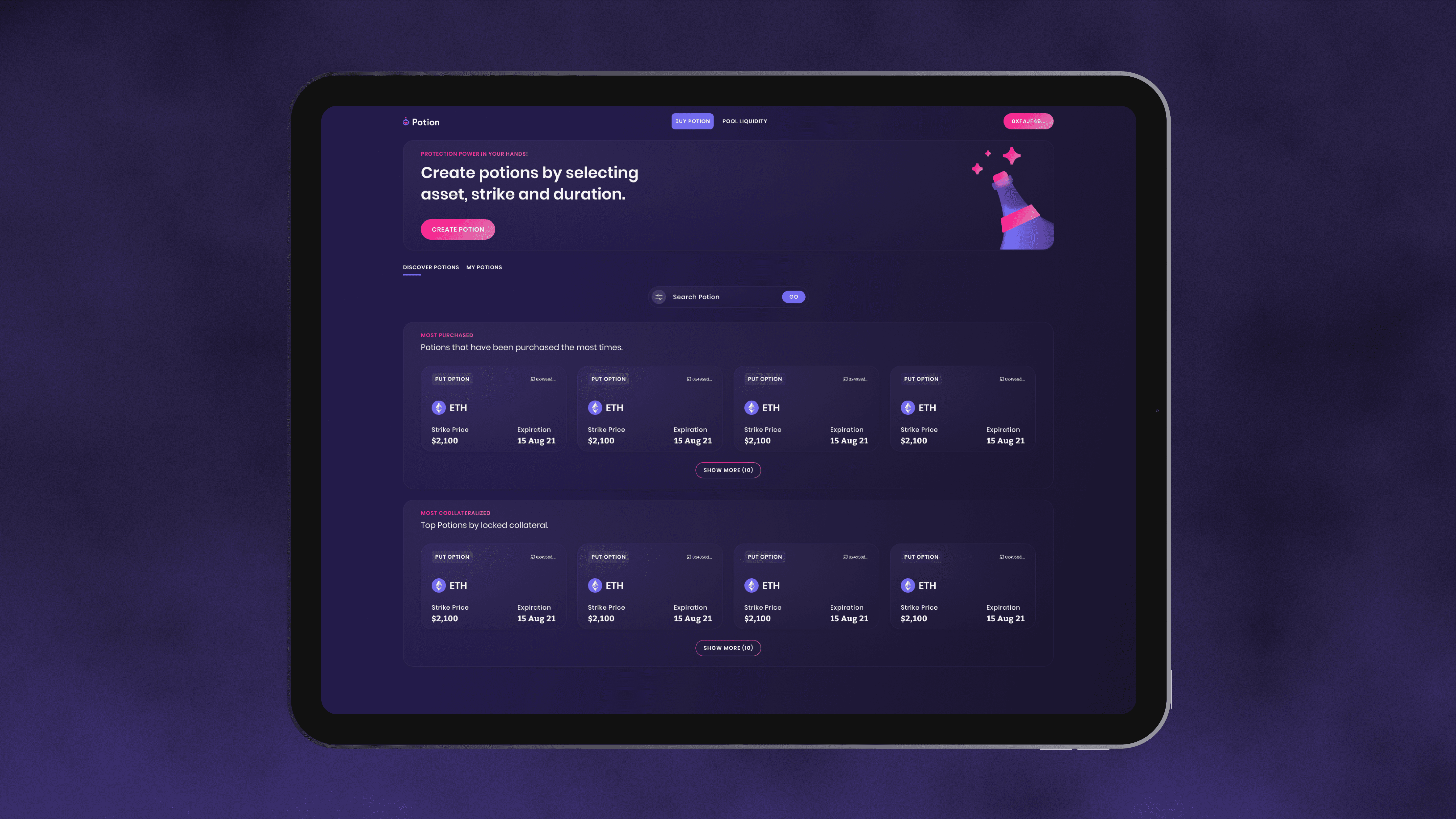
Following early recognition and a successful seed round, the project evolved into a full web application enabling a decentralized marketplace between protection buyers and liquidity providers. At its core, the protocol integrates the Kelly Criterion to optimize pricing models for on-chain insurance contracts.
The Challenge
Translating complex option theory into an accessible web experience
Designing dual-sided market flows for buyers and liquidity providers
Visualizing bonding curves and risk parameters in an intuitive way
Building a scalable design system for a mathematically intensive product
From Prototype to Product
The initial prototype was developed in five days during HackMoney, covering brand direction, UX structure, and a working interface on Ethereum Testnet. While visually minimal, the early version established the core interaction model that later evolved into the production web app.
Product architecture
The web app was structured around three core participant roles:
Protection Buyers
Liquidity Providers
Pool Creators
Each role required distinct flows while interacting with the same underlying financial logic.
Core User Flows
Creating a Potion
Buyers can mint custom insurance contracts by defining strike price and duration. The interface breaks down option parameters into a structured four-step flow, abstracting financial complexity into guided inputs.
Buying a Potion
Once minted, Potions can be purchased by any participant matching the selected parameters. The system operates as an open marketplace, optimizing gas efficiency while preserving transparency in price and risk exposure.
Creating a pool
Liquidity providers create pools by defining custom bonding curves that determine pricing dynamics. This required designing interfaces capable of representing non-linear pricing models in a comprehensible way.
Cloning pools
Pools can be cloned by other participants, replicating pricing parameters while operating independently. This mechanism encourages strategy experimentation and decentralized expansion of liquidity.
Design System
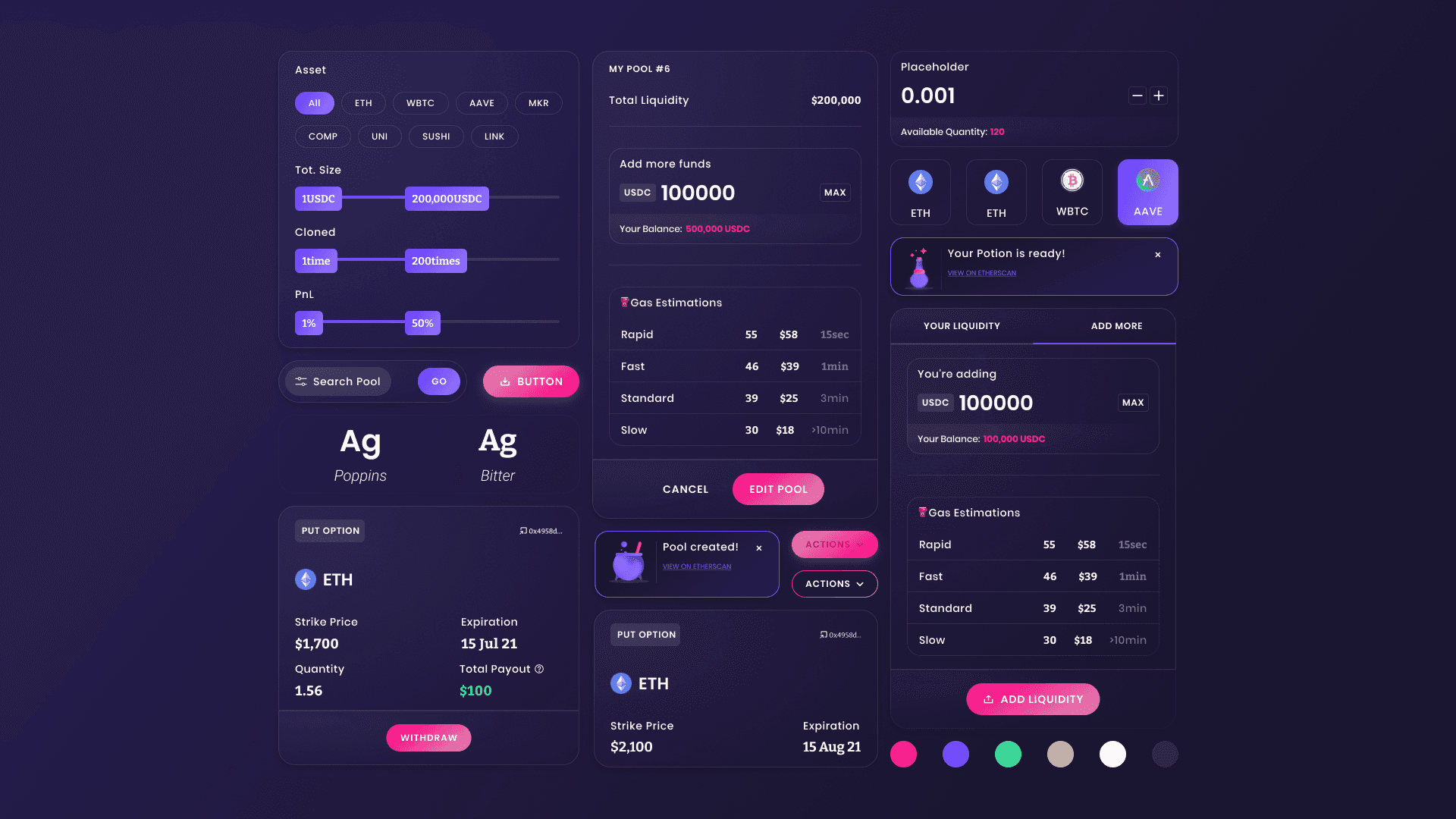
A custom UI library was developed using Vue to support the protocol’s complexity. The design system included reusable components for financial inputs, bonding curve visualizations, and multi-state interactions—ensuring consistency across a mathematically dense interface.